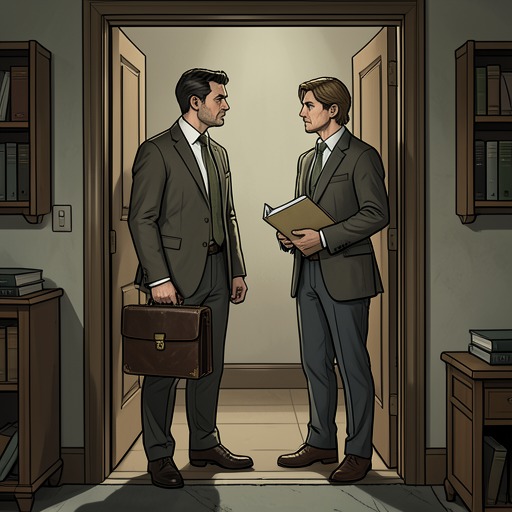
Joe Silvermann’s murder disguised as suicide
Down Cemetery RoadJoe Silvermann’s murder disguised as suicide is the event that converts Sarah Trafford’s uneasy connection to a private detective into a danger she cannot simply walk away from. Joe is found with his own razor in his hand, an image that could pass for suicide; Sarah nevertheless recognizes the scene as false. As the investigation proceeds, evidence that her file has vanished and that a cheque of hers was found in Joe’s wallet makes the apparent explanation look less like a private death than a message—and part of an effort to implicate her.
The office and the staged impression
Sarah arrives at Joe’s office intending to leave a cheque. The street is unusually empty, and a man in a white jacket stands in the doorway of the Italian restaurant opposite. He looks towards her before lighting a cigarette. Sarah notices him, though at first the detail is only one among the small uncertainties of an awkward visit. The outer door is unlocked; so are the doors to Reception and Joe’s office. She calls Joe’s name, knocks, and considers waiting or leaving the cheque on his desk.
Afterwards, Sarah tries to reduce what she saw to one image: she thought Joe was wearing a tie, a bright red one. The impression lasted only a second or two, but it offered a more comforting version of the scene than the truth. She was not fooled by the razor in Joe’s own hand. The detail matters because it distinguishes a fleeting attempt to soften what she has seen from her settled judgment about how Joe died: the apparent suicide is persuasive only if that judgment is ignored.
Sarah also understands that leaving quietly would have been safer. The man outside the restaurant had seen her, but that is not the only reason she stays involved. She cannot leave Joe as though he were an unfinished task or an object she had put down and forgotten. Her reluctance gives the murder an immediate personal consequence: even before she knows who is responsible, she has become a witness who cannot simply erase her presence from the story.
Suicide as the official explanation
Inspector Ruskin questions Sarah about her relationship with Joe and produces a folded slip of paper. He points out that she had never actually met Joe, then asks how a cheque of hers came to be in his wallet. Sarah has no easy explanation to offer. The cheque links her to a man she says she had not met, making her visit look suspicious even as it gives the police a reason to examine the supposed suicide more closely.
There is no suicide note. Ruskin nevertheless tells Sarah that he thinks Joe killed himself and that Joe had good reason. His conclusion sits uneasily beside the facts he is investigating: the unexplained cheque and Sarah’s claim that she never met the detective. The scene does not make suspicion disappear; it shows how an official explanation can coexist with unresolved details. Sarah, for her part, does not accept suicide simply because Joe’s razor is in his hand.
The missing file and the warning
The decisive change comes when Sarah discovers that Joe’s files contain no trace of her under Sarah Trafford, née Tucker. She believes Joe would have kept a record of a client, even if he had failed to cash her cheque. The absence therefore looks deliberate: someone removed her file after killing Joe. In Sarah’s interpretation, the murder and the erased paperwork belong together. Joe was killed, and she was being warned.
The warning appears to have another purpose as well. Sarah connects the missing record to an attempt to fix her up as part of a drugs ring. Zoë Boehm supports the central point that Joe was not involved with drugs: she insists he neither used nor sold them, and says someone planted the drugs. Her account does not make Sarah’s danger less immediate; it strengthens the suspicion that the apparent evidence against Joe, and the evidence directed at Sarah, has been arranged to mislead.
At first Sarah suspects Gerard Inchon, while acknowledging that she cannot make the full chain of events fit and cannot imagine him personally entering her house or using Joe’s razor. She concludes that he must have had an accomplice, or more than one. That uncertainty is important: Sarah can recognize that Joe was murdered and that she has been targeted without yet knowing who carried it out or where Dinah Singleton is being held.
Accusation and consequence
Later, Sarah confronts Rufus directly: “You killed Joe. You planted the coke.” Rufus does not answer with an explicit confession in the exchange, but his response shifts the conversation to Sarah’s return and asks whether she is still searching for the child. The scene makes the murder part of a wider effort to divert or intimidate Sarah, rather than an isolated crime. Rufus is Axel Crane operating under a cover identity, so the confrontation points toward the machinery behind the staging without making every detail of the killing explicit.
The murder’s force lies in the gap between what its props claim and what its consequences reveal. A razor in Joe’s hand can suggest suicide; a cheque in his wallet can make Sarah look connected to him; a missing file can erase the record that would explain their connection. Taken together, those details turn Joe’s death into a means of manipulating Sarah and obstructing her search for Dinah. Sarah’s refusal to accept the staged account keeps the case open, but it also draws her further into the danger the murder was meant to impose.